What were and are the EU’s primary objectives? Have they been achieved or significantly enhanced?
There is a lot of idealism behind both the idea of a European union and the support for the Union that currently exists. There are theories on how to achieve these ideals but theories must be weighed by outcomes and these have been underwhelming.
In our view, none of the EU’s main objectives have been achieved or much enhanced. One reason is that theory has driven policy more than its response to real outcomes.
The initial objective was to construct a peaceful Europe that would never again trigger global conflicts. Coupled with that was the wish to create a more equal and prosperous community of nations – also a fine objective and one that, in theory, should reduce envy and therefore reasons for conflict.
There have been wars in Europe since the earliest stages of the Union but none between EU member states, so there is a correlation with it’s founding; but there were other factors which may have mattered more – such as NATO, MAD (Mutually Assured Destruction) and the end of empires. Mostly the member nations have become more prosperous but the rate of improvement relative to other regions has not been great. To a degree the system has taxed and redistributed funding but wealth differences remain large.
The economic benefits of membership are uneven. Poland receives a good proportion of available subsidies but doesn’t seem overly grateful, or at least its government is one of the most resistant to instructions given by the Commission; actually Poland’s economy is doing rather well but the reasons are more than just the opportunities and subsidies afforded to it by the EU. Bulgaria was liberated from Soviet control and joined the EU at much the same time but its growth and prospects are not as rosy.
We can compare different nation’s growth rates for every quarter from 2000 to 2022 with this elegant tracker:
[https://www.cfr.org/article/global-growth-tracker-world-economies-gdp] – clearly members of the EU have not moved in synchrony nor converged.
Next up is security. Imperial conquest and confrontation have re-emerged from Russia but the Union has not been at the forefront, or indeed strongly united in its response. Poland is poles apart from Hungary; France and Germany have wavered between appeasement and effective action; Italy is divided (exemplified by Meloni versus Berlusconi (until the latter’s recent death he still regarded Putin as a buddy); yet the UK (apparently the model for imperialism) has led Europe in facing down the aggressor.
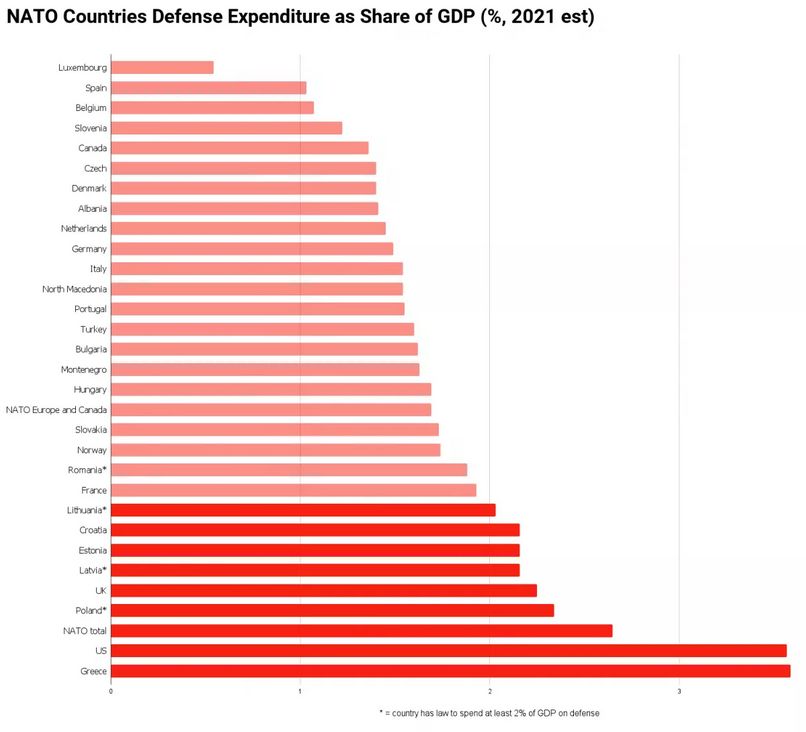
Most member states don’t meet their commitments to defence capability, except those that feel most threatened by Russia – Finland, Lithuania and Poland especially – and Sweden has abandoned its long-held neutrality. Ukraine wishes to join NATO and the EU, but the latter wish is understandable as it needs to end its relative isolation and increase the moral obligation of the hesitant Union. Ukraine may well benefit from the trading relationship (whereas the UK had plenty of relationships anyway, some abandoned to meet the EU’s entry requirements) but existing members are wary of the level of subsidy entitlement under the current system.
Another plank in the platform of EU idealism is “European Values“. These are defined – well, listed rather – in the Treaty of Lisbon but they are not easy to quantify so their improvement as a result of union is hard to measure. The term is practically a neologism, having been declaimed so often. This is an area where Poland is at odds with the Commission, which accuses its government of violating democratic principles, a sacred value.
Yet democracy is a dangerous thing in Europhile minds; after all the Union was formed in the aftermath of WW2, and Hitler was an elected leader. Better then that the people are guided by wise folk, unknowingly if necessary, to the “sunlit uplands” of a unified Europe.
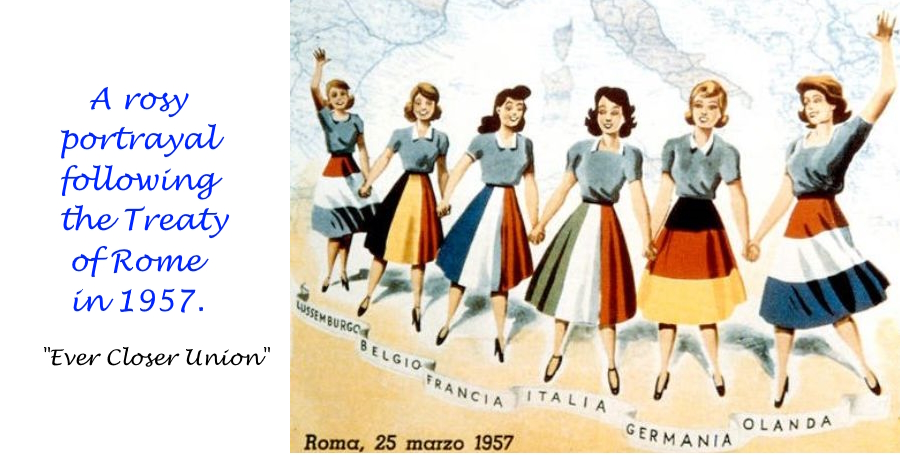
Unification is actually the primary objective of the EU, its theory being that this, above any other means, will bring peace, prosperity and equality to our hitherto, fractious continent. Thus the ends and the means have been inverted. But the means are unproven, as we have discussed before.
Some of these ideas have been discussed more fully in previous blog posts, for example:
All I Want is Peace; The Project for Peace
Economic growth in the EU relative to trend and to other trade blocks: Did the EU Bring Us Growth?
[2] https://www.debatingeurope.eu/2021/04/19/what-are-european-values/
[3] from our blog: Goals and Values
[4] “All our eyes on, the distant Horizon”
 This EU Won't Work